MY friend and comrade Gerry Kelly has announced his decision not to stand in the Assembly election next May. That does not mean that he will no longer be a republican activist. No chance of that. As I found out when I stepped back from electoral politics, there is still a lot to do. And I am certain Gerry Kelly will also find that to be true.
Gerry’s commitment to ending the union with Britain and building a new Ireland based on equality and respect is well known. As is his courage and determination in the face of enormous challenges. He spent 15 years in prisons in Ireland, Britain and Europe and was 205 days on hunger strike. For 167 of those days he was force-fed by having a tube inserted into his nose – “like a red-hot needle being pushed into one’s head”, he later wrote – and a wooden clamp jammed between his teeth to hold his jaws open while a feeding tube was fed down his throat.

He was in solitary confinement in Mountjoy, Brixton, Wormwood Scrubs, Long Lartin, Maastricht, Amsterdam, the H-Blocks and Crumlin Road prisons. He attempted to escape several times and succeeded in the Great Escape from the H-Blocks of 1983 with 37 comrades.
I have many fond memories of working with and socialising with Gerry, including on one occasion when he and I drove over to Lissadell House in County Sligo, childhood home of Countess Markievicz, to listen to Leonard Cohen sing. It was a beautiful summer evening in 2010. Leonard had an affection for Ireland and occasionally he sang ‘Kevin Barry’.
Gerry is a wonderful dancer. In Lissadell Leonard started his set and after a time Gerry found a spot near the beer tent, where he was soon moved to go into the dancing repertoire he’d developed in solitary, listening to the music in his head. A crowd gathered around him. “Dance me to the end of love,” sang Leonard. “Dance me through the panic ‘til I’m gathered safely in.” Gerry moved more deeply into synchronicity with the song, fluid, absorbed, committed, his whole body in it in an expression of melodic wonderment. From the stage Leonard stopped mid-verse to salute him. I basked in the reflected glory of Gerry’s rhythmic perambulations. “I’m your man,” I told him.
As an elected official and negotiator Gerry has been a formidable representative for Sinn Féin and for the people of North Belfast. In the early 1990s he and Martin McGuinness engaged in secret talks with the British. He was one of our negotiating team for the Good Friday Agreement and in many subsequent negotiations, most frequently on policing.
Gerry is a very fine writer. I have an Australian friend who frequently tells me that Gerry’s book – ‘The Escape: The Inside Story of the 1983 Escape from Long Kesh Prison’ – is the best book he’s read on the struggle. Gerry has also written a memoir and two books of poems.
So well done, Gerry. You won’t get away that easy – but you know that! Good luck to you and Margaret and all your clann.
Mayo-bound for a post-Sam tribute to the ‘81 heroes
WELL done Mayo in the all-Ireland football final. Commiserations to Kerry. Both teams played their hearts out but in the end Mayo were worthy winners.
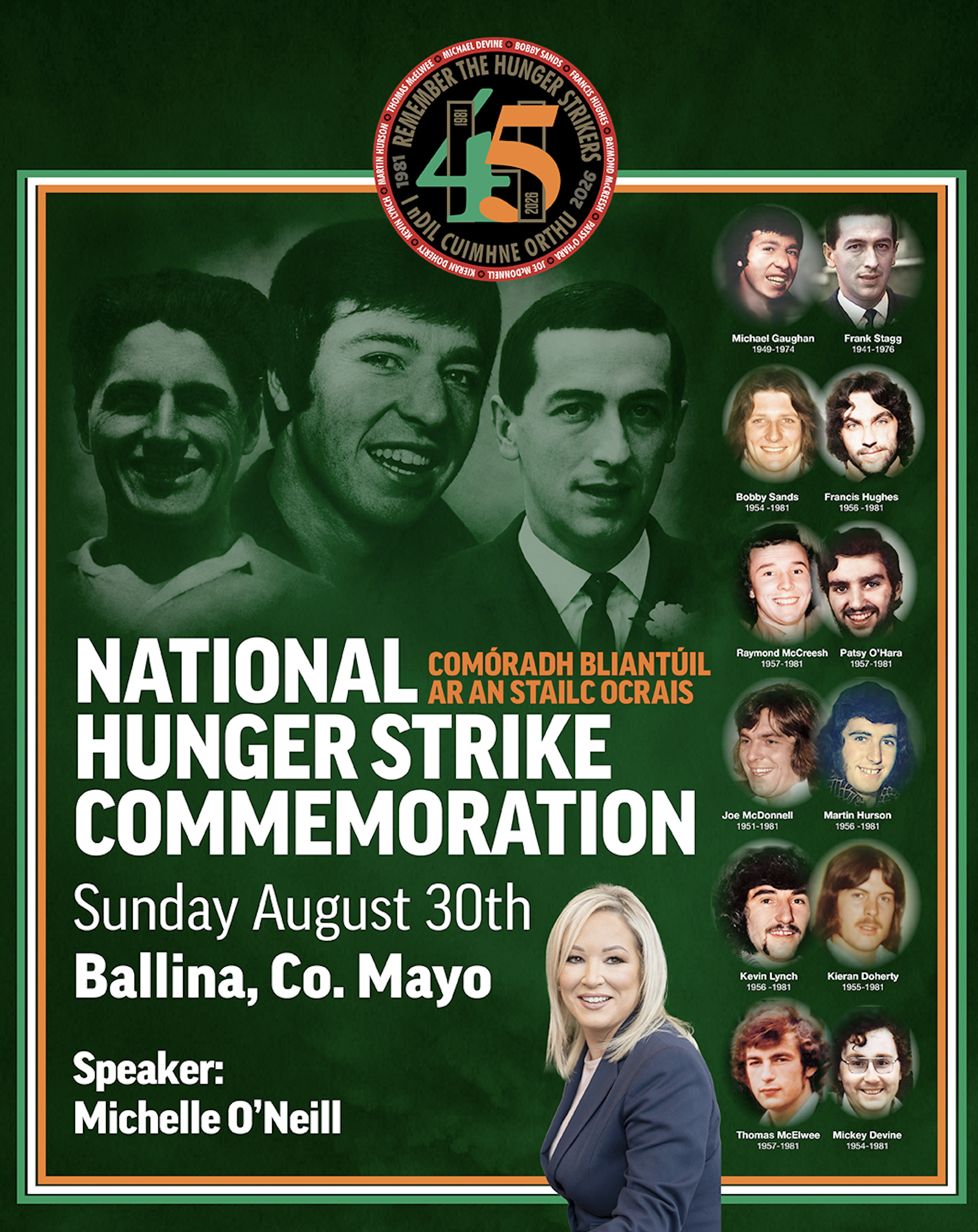
Next month on August 30 I will be in Ballina, Mayo, for the 45th anniversary of the 10 hunger strikers who died during the 1981 hunger strike. The event will also remember the three Mayo hunger strikers: Jack McNeela (1940), Michael Gaughan (1974) and Frank Stagg, (1976).
22 Republican prisoners died on hunger strike in the 20th century.
I am always mindful when talking or writing about the hunger strikers of their families who throughout the blanket protest in the H-Blocks and in Armagh Women’s Prison, endured the trauma of the protest with them.
In recollecting that period I have an advantage over most people in that I was in the Cages of Long Kesh when special category status ended and the blanket protest commenced in September 1976, when Kieran Nugent bravely refused to wear a convict’s uniform.
Later again I was part of the campaign in support of political status.

In 1978 I was arrested again and spent eight months on remand – part of that time was in the H-Blocks. Because I was designated a special security prisoner I saw some of those blanket men who were taking visits. They were like characters from Solzhenitsyn’s Gulag, shuffling along in big boots without laces, wearing, for their visits, ill-fitting jackets and trousers. Most of the trousers had their backsides slit open, and all of the blanket men had long, unwashed hair and unkempt beards.
When the case against me collapsed in September 1978 I immediately became involved in the campaign in support of the prisoners.
In the years that followed there were big dramatic moments, not least when a hunger striker died or when Bobby Sands was elected MP for Fermanagh South Tyrone, or when Kieran Doherty and Paddy Agnew were elected as TDs or when the British army attacked Joe McDonnell’s funeral.
The great dignity and grace and welcome that the families of the hunger strikers gave to people like myself and Martin McGuinness and others was inspiring. So was the utter generosity of the hunger strikers, their indomitable spirit, their refusal to break.
The 1981 hunger strike was our generation’s 1916. It gave an impetus to the struggle that remains as strong today as 45 years ago. It accelerated the drive into electoral politics. And it gave a real stimulus to our efforts to build Sinn Féin as a radical republican party across the island.
The British government—and we have to remember that it was a Labour government who precipitated the prison protests and hunger strikes – sought to criminalise the republican struggle and failed. In large part because it didn’t take into account the sheer heroism and courage of people like Kieran Nugent and all those other, mostly young, men who went into the H-Blocks, and the women – the unconquerable women – of Armagh Women’s Prison.
Today republicans are in a stronger place than at any time since partition. But that means we have to be strategic, we have to plan, we have to organise, we have to prepare for the future – and to do that we need to learn from the past.
Bobby Sands contextualised all of this for us. It was he who said – and he was with James Connolly in this regard – that when the people of Ireland have the desire for freedom in our hearts, it’s then we’ll see the rising of the moon. In other words, the people will free themselves.
The re-conquest of Ireland will be by the people of Ireland.
And he also said, in a wonderful gesture towards everyone, that our revenge will be the laughter of our children. So thank you, Bobby, and thank you to all your comrades and to the families of our hunger strikers.
See you in Mayo, in Ballina, on August 30.
Pointless
LAST week an explosive device was discovered in a car in County Monaghan, apparently on its way North. Whoever was responsible for this irresponsible action is actively working against the significant opportunity that now exists to end partition.
Public and political support for Irish unity is stronger now than at any time since partition was imposed over a century ago. The conversation on unity crosses all political and community sectors. Apart from Fianna Fáil leader Micheál Martin, there is a growing consensus among the broad nationalist and left parties across the island that Irish unity is a winnable objective and offers the best prospect for a better future for all of the people of our island.
Those who were behind the attempted bomb attack have little support and no political strategy. By their actions they undermine the very objective which they claim to aspire to – a united Ireland. On the contrary, they play into the hands of those in the British system and within sections of political unionism who are opposed to the peace process and to its potential for achieving Irish unity.
The political reality is that there is no rationale for armed actions or for the existence of armed groups of any kind. They should desist and disband. If they have a political strategy, then put it to the people next year in the local government and Assembly elections.
There is no room for ambiguity on this issue. Those of us who believe passionately in a united Ireland are successfully engaged in pursuing the political and democratic path opened up almost 30 years ago in the Good Friday Agreement. Everyone who claims to be republican should be part of that peaceful effort to end the union. Anything else is a distraction.