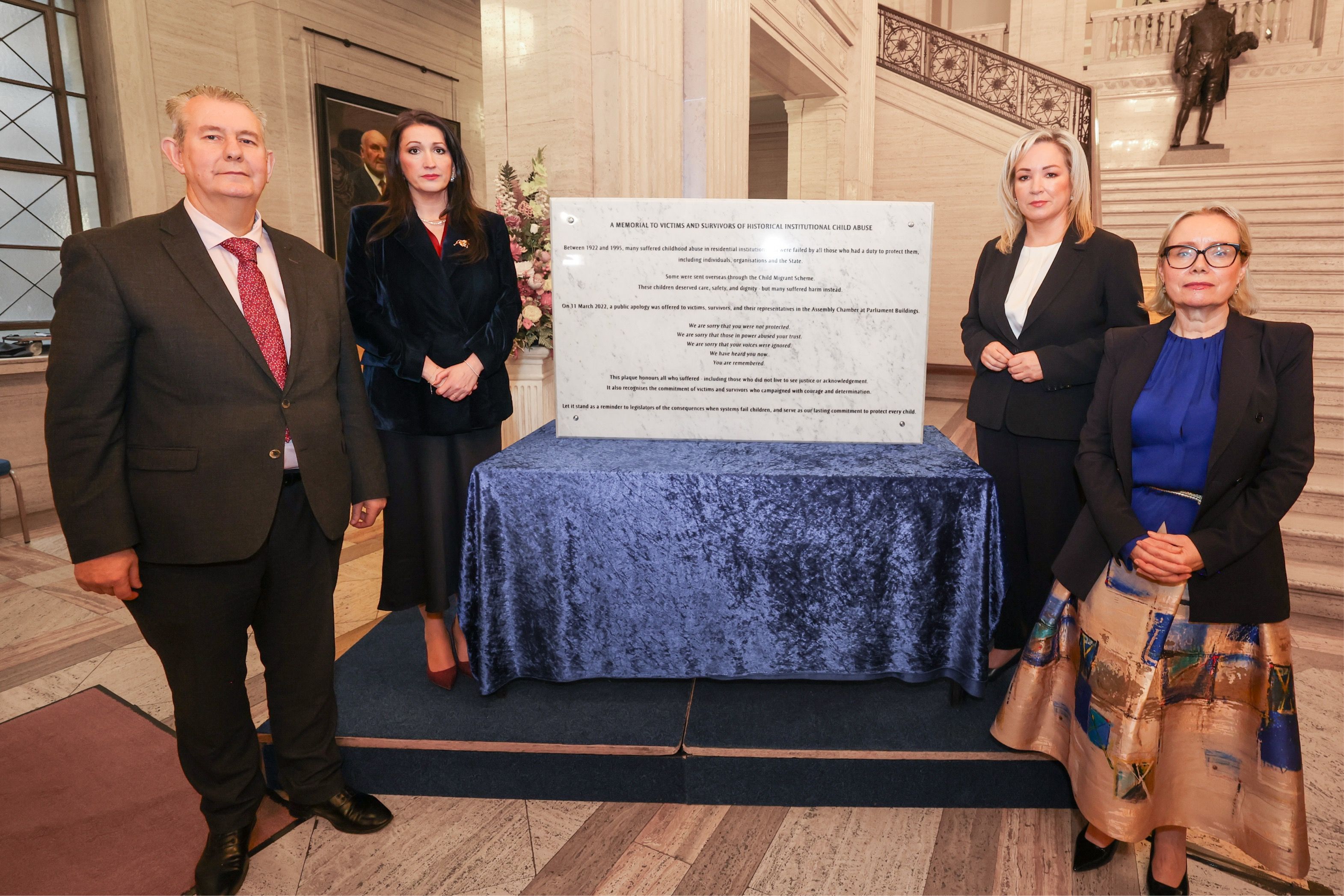
A MEMORIAL plaque has been unveiled at Stormont to honour all victims and survivors of historical institutional abuse.
The plaque stands as a permanent acknowledgement to the children who suffered abuse in residential institutions over many decades and fulfils the final recommendation of the Historical Institutional Abuse Inquiry.
Speaking at the event First Minister Michelle O’Neill said: “Today we honour the victims and survivors of historical institutional abuse and acknowledge the profound wrong done to children who should have been protected and cared for. What happened was never their fault.
“This memorial stands as a permanent acknowledgement of those failures by individuals, organisations and the State, who had a duty to protect children. The wording of the plaque reflects the voices of victims and survivors, whose courage in speaking out made this possible.”

The deputy First Minister, Emma Little-Pengelly said: “Victims and survivors have courageously shared their experiences and brought truth into the open. Their voices have shaped this memorial and continue to guide how we acknowledge the past and protect children today.
“We remember those who did not live to see recognition, and we remain committed to listening to survivors and ensuring their experiences help build a safer future for every child.”
Victims and survivors, representative groups and families of those victims who are no longer with us attended the unveiling ceremony at Stormont, marking an important milestone in acknowledgement and remembrance.
The stone memorial was created to fulfil the final recommendation of the Hart Inquiry into Historical Institutional abuse. The inquiry suggested that a suitable physical memorial should be erected in Parliament Buildings, or in the grounds of the Stormont Estate, which would serve as a lasting legacy to the victims and survivors of historical institutional abuse.
The Assembly Speaker, Edwin Poots MLA, said the event was an “act of recognition, reflection and remembrance”.
“We recognise that victims and survivors have different personal experiences, and different views on how they should be remembered. We reflect on the wrongs that were inflicted on the most vulnerable by those who should have been offering their care and protection. We remember those who are no longer with us to see this day,” he added.