WE look at the stories that were making the headlines in the Andersonstown News this week in 1985...
Growth in Irish despite attitude of the state
THE survival of the Irish language in a state which has been blatantly hostile to its existence is undoubtedly a remarkable achievement. But the Irish language in the six counties is not only surviving, it is flourishing and is stronger now than at any time since the northern state was founded. And although the British government has never allowed a language question on census forms there is an increasing recognition that there are two languages in common in the six counties – English and Irish.
After 64 years of partition the laws of the northern state still only allow for the existence of one language, English, and the machinery of the state is still used to discriminate against the native language.
What progress their language has made has been achieved largely without the help of the state.
The establishment of the Shaws Road Gaeltacht in the late 1960s and then the Bunscoil Gaelach in the early 70s is typical of the independent spirit of the present generation of language activists. Having brought together about ten families who were raising their families with Irish several of the parents decided that it was essential to educate their children through Irish. In the space of three days an old portacabin was purchased, placed at the back of the Gaeltacht houses and on Monday morning the school began.
Today after a 13 year struggle for state recognition which mobilised many people in Belfast and throughout the North, there are over 200 children attending Scoil Ghaelach Bhéal Feirste. Although much has still to be done, its future does seem assured. The concept of education through Irish is now widely accepted and within a period of years a Meanscoil – an all-Irish secondary school in Belfast – appears likely. Indeed the fruits of what has been achieved by the bunscoil will not be felt for some years yet. Meantime there are four naíscoileonna in Belfast, a fourth in Derry and another is being planned for Newry.
Later this year Feis Bhéal Feirste, the popular schools feis competition will make a welcome return after a ten year absence. Recently, the INTO decided to review the teaching of Irish in schools and to produce a new policy document. At present about 20,000 pupils study Irish at school here although it still remains a ‘no-go area’ in the majority of state sector schools.
But while there are encouraging signs the situation of Irish in most schools in the six counties is far from satisfactory. In many Catholic primary schools and secondary schools Irish is not even offered as an option, and in others it is only offered to those who have done badly in exams. The deterioration of the status and standard of Irish in schools has caused much concern to Irish speakers and parents of pupils.
Black taxis for North Belfast
FROM next Monday (22nd April) Black Taxis will be operating in North Belfast. Announcing the news, a spokesperson for the West Belfast Taxi Association said the expansion would provide up to ten jobs for local people and provide a competitive alternative to Citybus.
The service will start at 7 a.m. from the Star Club at Balholm Drive and travel via Ardoyne Road, Oldpark, Rossapenna, Cliftonville Road, Antrim Road, New Lodge Road, through Millfield to Castle Street. Fares will be 30p for adults and 20p for children and OAP's regardless of distance travelled.
"This scheme has been set up in response to the many requests received from local people," said the Taxi spokesperson.
MAY COUNCIL ELECTION ’85: Sinn Féin candidates for Lower Falls: Fra McCann, Seán McKnight, Seán Keenan and Lily Fitzsimmons; Upper Falls: Alex Maskey, Teresa Holland and Máirtín Ó Muilleoir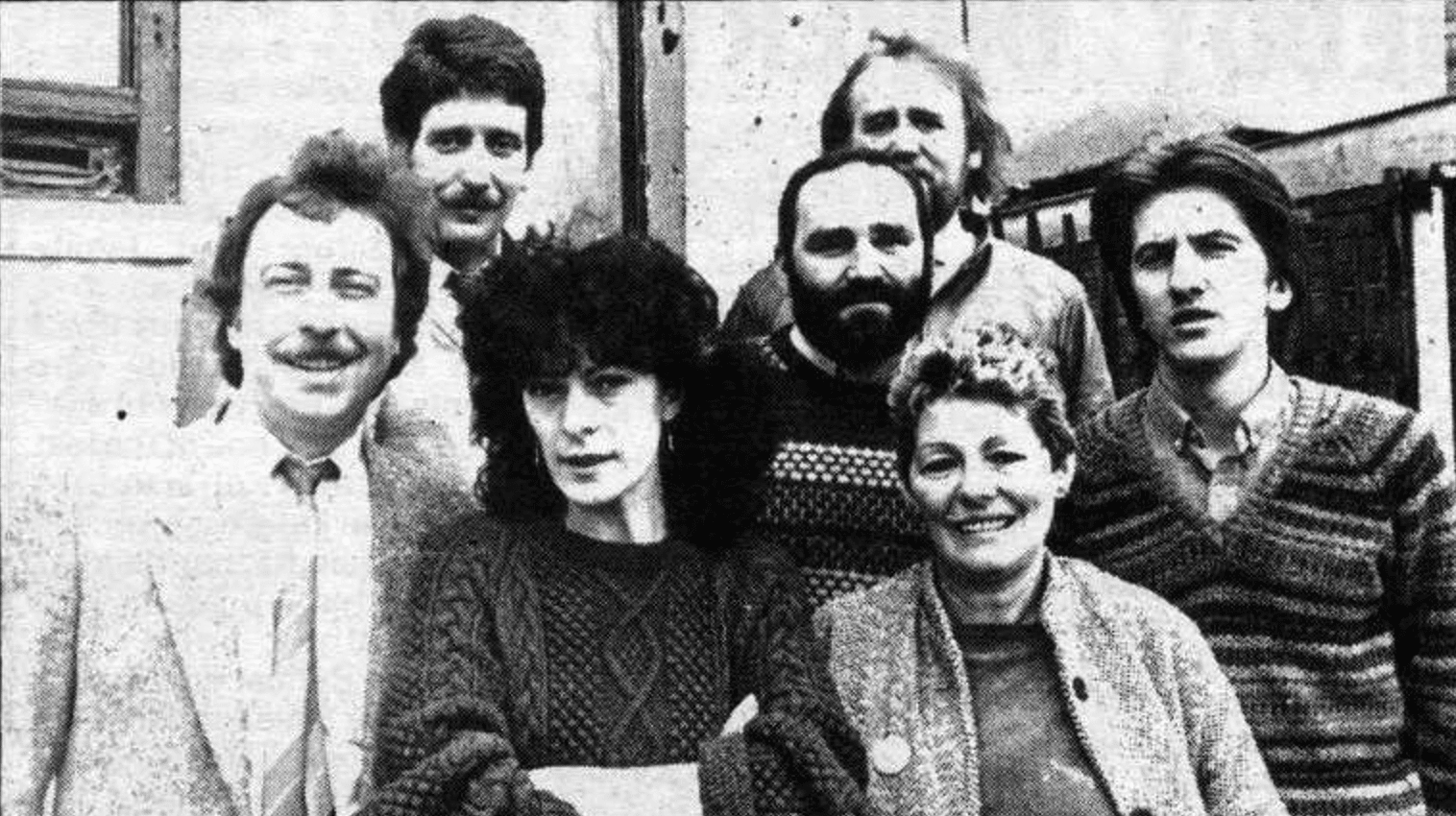

Editorial
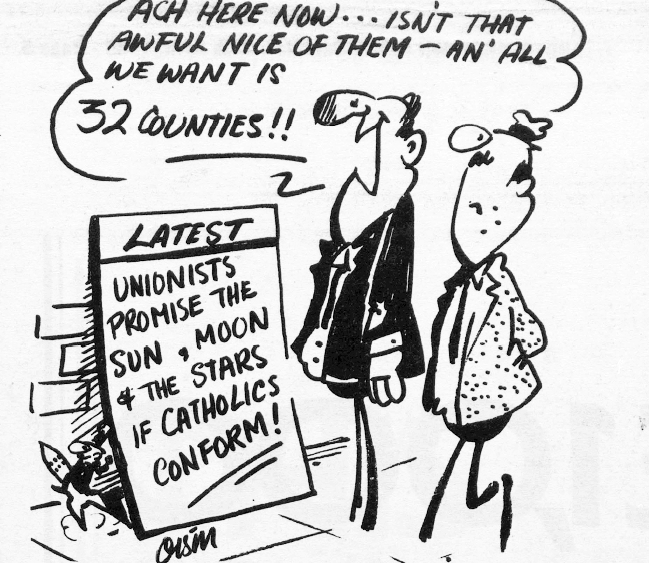
DESPITE the DUP's large clerical membership and religious fanaticism, it doesn't prevent it from engaging in a bit of kite flying from time to time, and its latest "revelations" on an Irish/British blueprint for the Six Counties is nothing more than that.
But even if some of the leaked details are true, we can't see why the DUP or any other Unionists, should be worried about them. Because the two governments involved are very much pro-unionist in their outlook and all their deliberations are aimed at getting Nationalists to accept the Six County State, much along the lines of the Workers' Party's conversion to that point of view.
Needless to say we think they are entirely misinformed about the strength of nationalist feeling on the existence of the Six County State, and no amount of tinkering with the system will make any difference. We believe that the situation has gone beyond cosmetic reforms, and laughable though it may seem now, let's not forget that one of the British Government's "reforms" in the early 70's involved changing the RUC uniforms to a green colour. Such was the depth of their ignorance of the problem then, and we don't think things have changed much since.
If the RUC is not acceptable to a large section of the nationalist population, it is not because they are any worse than police forces anywhere else, or because they are any more cruel. But because they are upholding a system and a state that is morally wrong because it prevents the Irish people as a whole from realising their full potential as a member of the international community. That being the case, even if their uniforms were green, white and gold, it would still not make any difference; the moral principal would be the same
If on the other hand they were to renounce all responsibility for 'state security', lay down their arms, remove the trappings of state authority from their barracks and ban all membership of the Orange Order and Free Masons from membership, then we would have a talking point. But since no-one in their right senses could even imagine such a possibility, and the fact that there is not even the suggestion of radical changes like these in the DUP revelations, then they need not be too worried about the British and Irish deliberations. Whether they should be worried or not about the closing gap between Catholic and Protestant populations in the Six Counties is another matter.
According to the latest figures in the Irish Catholic Directory, we reckon the difference is now less than 200,000 or something around the population of West Belfast.
That now is a subject for some real British/Irish deliberations.