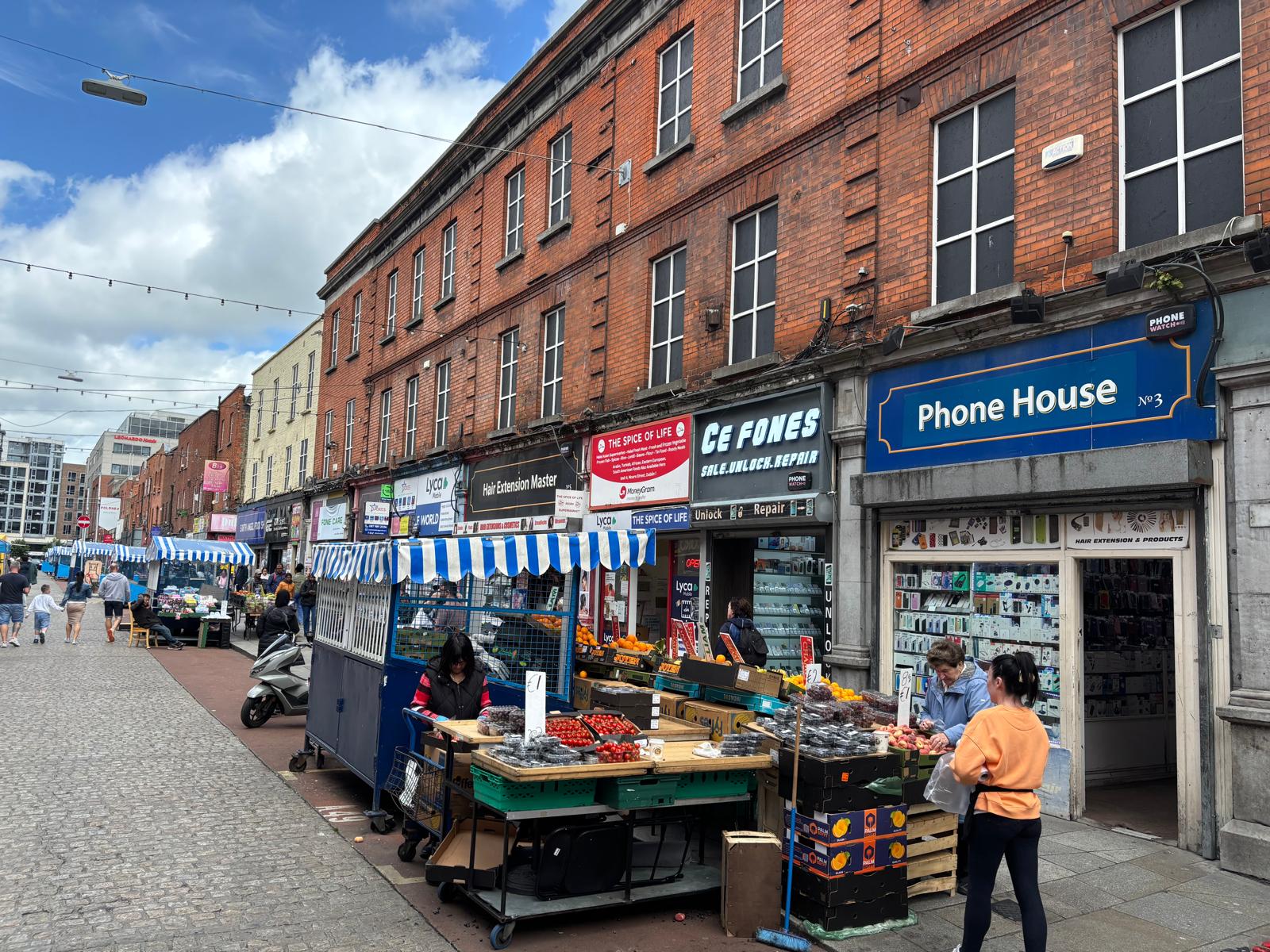
THE 1916 Moore Street Battlefield site in the centre of Dublin is a hugely important historical and cultural location whose significance has been ignored by successive Irish governments for over a century. Currently much of the Moore Street terrace and adjoining lanes are under threat of demolition by the London-based developer Hammerson.
The Moore Street Preservation Trust (MSPT), the Relatives of the 1916 Rising Relatives and others groups and individuals have been involved in a long- running campaign to save this iconic site.
Early next year the Moore Street Preservation Trust will be in court to judicially review the Hammerson plan. This is a vital step to preserve this historic area and the Trust is engaged in a campaign to inform, lobby and win support for its efforts.

As part of its campaign the Trust has launched a petition calling on the Irish government to bring Moore Street into public ownership and build a 1916 historical Cultural Quarter.
In addition, representatives of the 1916 Relatives and of the Trust met with the Executive Council of the Irish Congress of Trade Unions to brief them on the Trust's Master Plan for the area and to seek their support. The Trust delegation included James Connolly Heron, (great grandson of James Connolly); Honor Ó Brolcháin (Grand Niece of Joseph Plunkett); Christina McLoughlin (related to Seán McLoughlin); and Cllr Micheál MacDonncha, Secretary of the Trust.
DELEGATION: James Connolly Heron, Christina McLoughlin, Mícheál MacDonncha and Honor Ó Brolcháin before their meeting with ICTU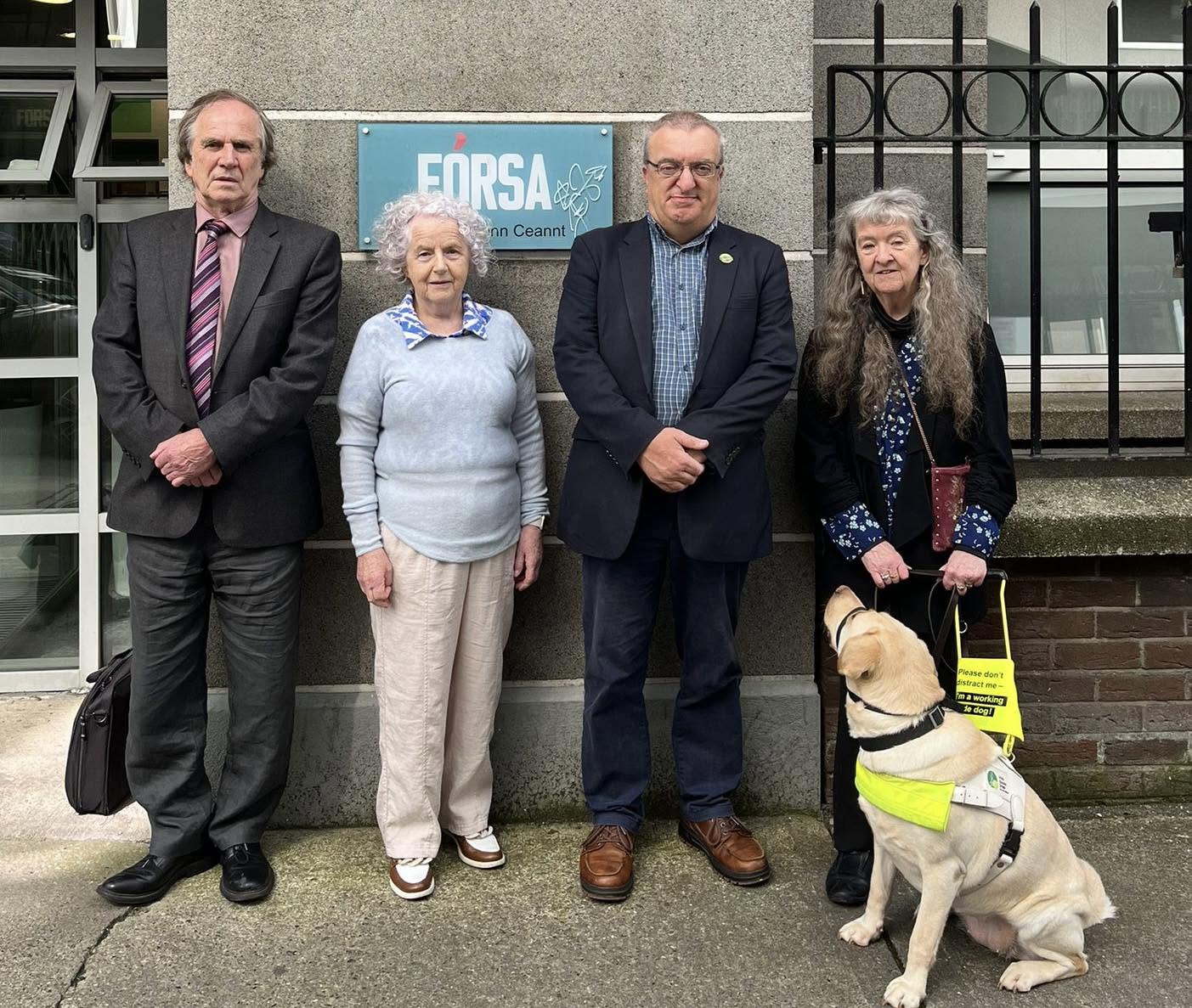

In a statement after the meeting, Congress General Secretary Owen Reidy described the Trust's plan as "credible, and exciting." He said that "Congress is committing our full support to it."
In a very welcome declaration of commitment, the General Secretary asserted the determination of the ICTU to be "active stakeholders in this process, and we will be making that case clearly to government and to Dublin City Council. Moore Street deserves a plan equal to its significance, and we believe that the Preservation Trust has provided one."
Finally, Aengus Ó Snodaigh TD challenged An Taoiseach Micheál Martin in the Dáil on the future development of the GPO and of Moore Street, and his concern at Hammerson's continued partnership with Allianz, which has been cited in a UN report as an enabler of Israel's genocide in Palestine.
Martin claimed that "there is some very good work being done on Moore Street by the State."
Aengus pointed to the fact that "there is no work happening on Moore Street" and accused the Taoiseach of misleading the Dáil.
As the date of the Judicial Review approaches, the debate around the future of the 1916 Moore Street Battlefield site is set to heat up. So well done to ICTU for backing the Trust's alternative Master Plan. This is the way forward.
Sínigh an achaint/ Sign the petition: www.change.org/p/save- moore-street-buy-the-terrace.
Féile is a salute to the past, the present and the future
I'M looking forward to July 25 when Féile an Phobail begins its longest and biggest ever summer extravaganza as the largest community festival on the island of Ireland.
The programme was launched last week and is an amazing mix of music, sport, Gaeilge, arts exhibitions, literary events, discussions and debates, comedy, film, tours and walks and much more. Over 500 events with something for everyone. An anticipated 120,000 tourists from outside of West Belfast will come along to join in the celebrations. The programme is available online at feilebelfast.com.
When we launched Féile in 1988 it was a much smaller event, taking place against the backdrop of an ongoing conflict. Only a few months earlier in December 1987 Ulster Resistance, the UDA and UVF had successfully imported hundreds of weapons with the help of British intelligence. This saw a significant rise in killings of republicans and nationalists as a result of state collusion with loyalist death squads. West Belfast was under military occupation. Heavily armed British army patrols, along with the RUC, were a constant presence and military forts were everywhere. West Belfast was a censored community with community groups frequently denied funding as a result of political vetting. There was no state funding for Irish medium education and discrimination permeated all aspects of life. There were also hundreds of political prisoners.
Back then West Belfast was deeply invested in a culture of resistance. But the killings in Gibraltar of three outstanding West Belfast citizens, Volunteers Mairead Farrell, Seán Savage and Dan McCann, the attacks on their funerals, the deaths of Thomas McErlean, John Murray and IRA Volunteer Caoimhín Mac Brádaigh, and two British soldiers, became a catalyst for transforming and accelerating that culture of resistance to a culture of change.
Féile an Phobail was one consequence of this. It was our alternative. It was us embracing hope and creativity and positivity. To reclaim our space. To create space for others. To enjoy ourselves. To say this is who we are. Not a terrorist community. But a patriotic, resourceful, intelligent, cheerful, confident, caring and hopeful community of people looking to the future. Enjoy Féile 2026. I will.
Taoiseach isolated
I WANT to begin by commending the SDLP for organising last week's conference - "The Future of these Islands: Preparing for Change'. It was a well- attended day-long event, held in Belfast, on the issue of Irish Unity. Among those who contributed to the series of discussions was Dublin Minister for Justice Jim O'Callaghan, former Taoiseach Leo Varadkar, Sinn Féin's Conor Murphy and others, including leading figures in the SDLP including the party leader Claire Hanna.
Add this to Fine Gael's announcement that it is planning to publish a blueprint on Irish unity at its Ard Fheis in November and next Tuesday's Dáil debate on Sinn Féin's legislative proposal-Planning for Constitutional Change Bill 2026' and it is clear that there is increasing unanimity in the unity movement that planning for unity is now a priority.
These are significant developments. Sinn Féin has long argued that the cause of unity is bigger than any one party. It requires the greatest number of citizens, political parties, community and lobby organisations all moving together in the same broad direction and planning for unity.
In July 2024 the Joint Oireachtas Committee on the implementation of the Good Friday Agreement, produced a landmark report which concluded that "there are no insurmountable barriers to Irish reunification." The report called for a whole-of- government approach to examine the implications of constitutional change and to begin the process of planning for Irish unity.
So, despite Micheál Martin's opposition to planning for unity it is obvious that many others are ready to engage in that process. Political unionism continues its no-engagement- on-unity stance, but elements of civic unionism have no such inhibitions. Ian Marshall and Joel Keyes made very pertinent remarks from an anti-unity position. Other former civic unionists bring a special perspective to planning for the future. Fair play to them.
Minister Jim O'Callaghan clearly understands the imperative of planning for the future. He told the conference: "It is responsible for an Irish government to set out what it is would happen, or what it is an Irish government would be prepared to recommend to its citizens if we were going to have a reunification referendum." He is right.
A tribute to Máire
THE conference room in the Sinn Féin Falls office was dedicated last Friday to former Sinn Féin Vice- President Máire Drumm by the current Vice-President of the party, Michelle O'Neill. Máire was assassinated in the Mater Hospital in October 1976.
She was a passionate, gifted and articulate advocate for Ireland and republicanism who frequently faced down armed British soldiers and RUC officers. The image of Máire leading a river of women into the Falls in the summer of 1970 to break the British army-imposed curfew, or her protests with women carrying hurling sticks, are iconic moments in the struggle for freedom.
The threats, the arrests, the periods of imprisonment never deterred Máire. Never broke her spirit or her determination to achieve an end to partition and a united Ireland.
Courageous people do not surrender hope- they embrace it.
That was Máire Drumm.