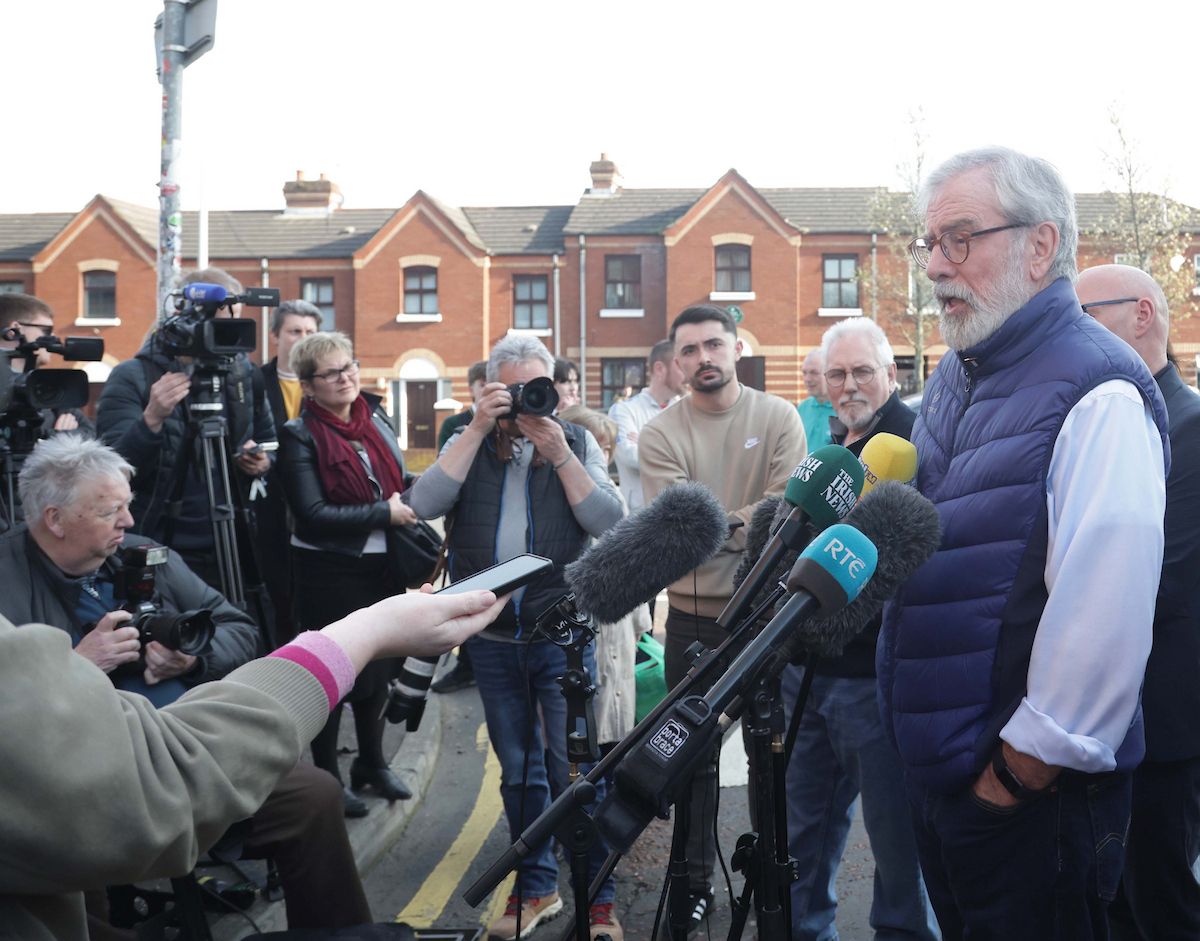
THE Civil Case against me in London came to an end last Friday when the claimants and their lawyers accepted a ‘drop hands’ settlement of the extant claim on the conditions that:
1. The claimants file and serve a Notice of Discontinuance by 10am 20 March 2026; and
2. That there be no order for costs.
In other words, they accepted an offer, made by me the previous evening, that they discontinue their claim. I instructed my legal team to make the offer because it was apparent at the end of day eight of the trial that the claimants’ case, as presented by McCue and Jury, the lawyers for the claimants, was in serious trouble. I gave them a way out.
After hearing from 11 witnesses, and my two days of evidence, it was clear that the claimants’ case was not built on evidence but relied on rumour, speculation, opinion, belief and propaganda. It was a rehash of last year’s BBC case in Dublin and of the worthless drivel that is sometimes presented as investigative reporting.

No documentary or forensic or direct evidence was produced linking me to the three bomb attacks that were at the heart of the case. The claimants’ lawyers went so far as to rehearse my family’s long involvement in republican politics going back to my great-grandfather’s membership of the Irish Republican Brotherhood in the 19th century. I learned things I never knew before. If they’re true.
At times it all verged upon a show trial. Anonymous agents of the British state hidden behind a screen, and others who were up to their necks in the subversion and collusion that was part of parcel of Britain’s counter-insurgency strategy in the North, making preposterous claims with no evidence to support them.
The former intelligence and security witnesses admitted under cross examination that intelligence is not evidence and that the British and RUC intelligence services often told lies, colluded with and supported the murderous actions of their agents and spies, and frequently produced misleading and erroneous claims.
It was even claimed in court that I had conspired to kill John Hume! One former Special Branch officer – Witness B – went so far as to claim that in all the years he worked on loyalist gangs he never saw any evidence of collusion. He finished his contribution by alleging that the IRA was responsible for the Omagh bomb.
My legal team challenged them on all of this, producing evidence from a series of official reports – the three Stevens reports; the de Silva report into the murder of Pat Finucane; and the recent Kenova report – all highlighting the extent of British state collusion with murder gangs and the lies they told to cover up their actions.
Following the collapse of their case McCue and Jury tried to explain away their decision by speaking of “an extraordinary and, in our clients’ view, unnecessary late intervention by the Court.” They claimed that the Court directed in the “final stages of the trial that it wished to consider whether the proceedings might amount to an abuse of process.”
The claimants’ lawyers also accused the Court of “unfairness” and said that their decision was related to possible costs that might fall to the claimants.
If the judge concluded that it was there was an abuse of process, he could order a ‘wasted costs order’ requiring the claimants’ solicitors to pay costs. I had made it clear that I wasn’t going to burden the claimants with my legal bill.
In fact, contrary to the claim by McCue and Jury, the judge’s remarks on abuse of process were not a last minute intervention. He had raised the issue a week earlier on Thursday, March 12. McCue and Jury made no protest at that time. The judge raised the issue again last Wednesday and asked both sides to again address this issue.

In his closing submission, my senior Counsel, Eddie Craven, explained: “It is well recognised that proceedings may be an abuse of process where they have been brought for the purpose of seeking some collateral advantage beyond the scope of the action and where the proceedings are conducted in a way designed to cause the Defendant expense, harassment or prejudice beyond the scope of what is ordinarily encountered in the course of properly conducted litigation.”
He pointed out that the claimants were seeking “vindicatory” damages of £1 each but on their crowdfunding platform and in the case documents it was clear that they were seeking to compel the High Court to undertake a protracted, wide-ranging public inquiry examination of the claims being made against me. They stated that their claim was brought for the purpose of “seeking genuine truth and reconciliation through a competent and compelling judicial process.”
On their crowdfunding page, which is titled ‘Time for Truth’, the real purpose of the case is spelt out. It is to procure “a proper inquiry into the Defendants’ alleged role in the Troubles” and an “exploration of the truth” which will “compel Adams to engage in an effective truth and reconciliation process” before the High Court.
The High Court case is not a public inquiry nor does it have the powers and procedures necessary to fulfil that role and consequently my counsel pointed out that “this claim is a clear example of the Courts’ processes being misused to achieve something not properly available to the claimants.”
He also addressed the issue of limitation. This essentially deals with the long delays in taking the case beyond the normal three years for cases of compensation. He also spoke about the burden and standard of proof required; the extent of hearsay and opinion evidence heard during the trial; and the evidence provided by the witnesses. For example, Witness A confirmed that he had no evidence to give in relation to the three bombings. As did Witness B. Shane Paul O’Doherty – an amadán and a fantasist – admitted that he had no information on the three bombings, had never met me or spoken to me and had never been in the same room as me – until the trial. And so it went on through the claimants’ witnesses.
As the case drew to a close, and while I am very sympathetic toward the victims who have clearly suffered, it was nonetheless increasingly evident that the case was in serious trouble.
Four years ago when this case first emerged I determined to defend myself against the false accusations being made. Throughout almost two weeks in London I asserted the legitimacy of the republican cause and the right of the people of Ireland to freedom and self-determination. I also reiterated my belief that the Good Friday Agreement provides a peaceful and democratic route to a new Ireland.
That needs a renewed focus, especially by the Irish government.
Finally, I want again to thank all of those who have expressed their solidarity, and the Sinn Féin team which worked closely with me. I especially want to thank Colette and our family. And buiochas mór to my legal team for their exemplary work.
Many who supported this case have one thing in common. They are against the changes that have been won as a result of the peace process. And the changes which are coming. They lost this time but they haven’t gone away you know. The British establishment continues its efforts to undermine those of us who made a stand against it in support of Irish freedom.
So until the next time, thank you, dear readers, for your support.
A massive loss to music
I HAVE always loved music. All kinds of musi. But I have a particular fondness for Irish traditional and folk music. I think by the time I heard De Danann’s first album, with Dolores Keane’s amazing voice leading the vocals, I was probably in Cage 11. That first Dé Danann album was incredible and over the subsequent years I never stopped being astonished by the uniqueness of Dolores Keane’s magnificent voice.
All of this came back to me while in London last week when I heard the news of Dolores’s death. It is an indescribable loss to her family but also to Irish music and to all of us who loved her music and her voice.
Dolores has been rightly described as a pioneer who led the way for other women in the music industry. For many she will be especially remembered for her contribution to the 1992 album, A Woman’s Heart , which she recorded along with Eleanor McEvoy, Maura O’Connell, Mary and Frances Black and Sharon Shannon. She was a musician and singer extraordinaire who captivated audiences and lifted our hearts with her ability to connect the words and the music with the audience. This was never more evident than on Caledonia.
Dolores will be greatly missed.