I RECENTLY came across the autobiography of British General Sir Frank Kitson which was published last year, shortly after his death. It is titled ‘Intelligent Warfare’, an oxymoron in any language. In truth, it is an account of British military failures through several colonial wars in which Kitson fought, including in Ireland. It is also a reflection of Kitson’s enormous personal ego.
Kitson came to prominence within the British military hierarchy in the 1950s during its efforts to crush the independence rebellion in Kenya. He established counter-gangs that tortured and killed Kenyan civilians. The groups were made up of British soldiers, including Kitson on occasion, and former members of those fighting against British rule. Tens of thousands of Kenyans ended up in over 150 detention camps where they were brutalised. An estimated 30,000 Kenyans were killed; one and a half million were interned; torture was commonplace; 1,090 were hanged.

While Kitson boasts of his role in the counter-gangs he ignores the human rights violations that underpinned British strategy in that African country. On 1970 he took command of the 39th Brigade, which covered Belfast and surrounding region. In the same year he published ‘Low Intensity Operations’, which quickly became the standard textbook for the British army’s counter-insurgency strategy in the following decades.
Kitson’s autobiography spends two chapters on his time in the North. In keeping with Low Intensity Operations and his use of counter-gangs, Kitson facilitated the merging in 1971 of a series of loyalist paramilitary groupings into the Ulster Defence Association (UDA). This organisation was to be run by a succession of British agents and informers.
In August 1971 Kitson was a key figure in the planning for internment, which he presents as a success. He claims that by Tuesday, August 10, 1971, the British Army had cleared Ardoyne; on Wednesday they “cleared out the Markets areas, Ballymurphy and Turf Lodge and on Thursday we cleared the remaining barricades in Falls Road and Springfield Road... Early on Friday 12 August a few isolated pockets were tied up and by midday the whole city was opened up and quiet.”
Nowhere does he detail the Paras’ actions in Ballymurphy. He writes about clearing out the area by the Wednesday, August 11, but in the 36 hours up to then 10 civilians, including Joan Connolly, a mother of eight, and Fr Hugh Mullan, a local priest, were shot dead by members of the First Parachute Battalion. An eleventh man died of a heart attack after a rifle was put in his mouth and the trigger pulled.
Kitson enthusiastically records his admiration for the Paras: “It was a great stroke of luck that at this testing time we had such splendid Battalions in the most difficult places. As always, 1 Para, which Derek Wilford, had taken over from Mike Gray in June, had done wonders, helping out in one trouble spot to the next.”
Kitson ignores the numbers killed, or the hundreds of families who were forced to flee their homes. His one reference to the Hooded Men – victims of British torture - is of a “few people that had been interrogated after the operation” using techniques “allegedly based on those used by the Chinese in Korea.” Kitson claims that he “knew little about it.”
Nowhere does Kitson mention the UVF attack on McGurk’s Bar in North Belfast in December 1971. Fifteen people were killed. Kitson, as Commander of the 39th Brigade, was one of those who sought to blame republicans for what the Brits and RUC described as a republican ‘own-goal’ despite forensic evidence available within hours proving that loyalists were responsible.
Kitson writes about Bloody Sunday. He ignores the findings of the Saville Inquiry which concluded that the 14 civil rights marchers killed on Bloody Sunday by the Paras were innocent. He doubles down on the lie that the IRA was involved. He claims that Wilford told him that “his men had been shot at and that in the ensuing action a number of presumed gunmen had been killed.” Kitson’s concern was that “1 Para would become less effective for a time because of the number of men that would have to give evidence to the military police investigating the incident.”
Kitson also admits that in 1971 he established the Military Reconnaissance Force (MRF), a secret unit made up of soldiers and former republicans which went on to kill civilians.
Kitson’s autobiography provides an interesting insight into the British military mindset. More importantly and ironically, it reveals why the British army lost in Ireland.
Intelligent Warfare – The Memoirs of General Sir Frank Kitson published by www.pen-and-sword.co.uk
A new media for a new Ireland must reflect a broader view of ourselves
A REPORT entitled ‘Public Media Ireland: a New PSM (Public Service Media) Organisation for a New Country’ has been published in Belfast. The report – a joint project by Dublin City University and Ulster University – recommends the setting-up of a new public service media organisation, Public Media Ireland, if citizens vote yes in the referendum for constitutional change.
Susan McKay, the Press Ombudsman, chaired the event. The four authors of the report – Dawn Wheatley, Roddy Flynn, Stephen Baker and Phil Ramsey – shared their vision of a public service media, or PSM, in a new Ireland.
The report recommends a single island public media structure and the values and ethos underpinning it. It does so on the basis that the debate on a new Ireland is under way. The authors are offering their report as a contribution to this debate.
CHALLENGE: Can a space be made for identities to be reconciled?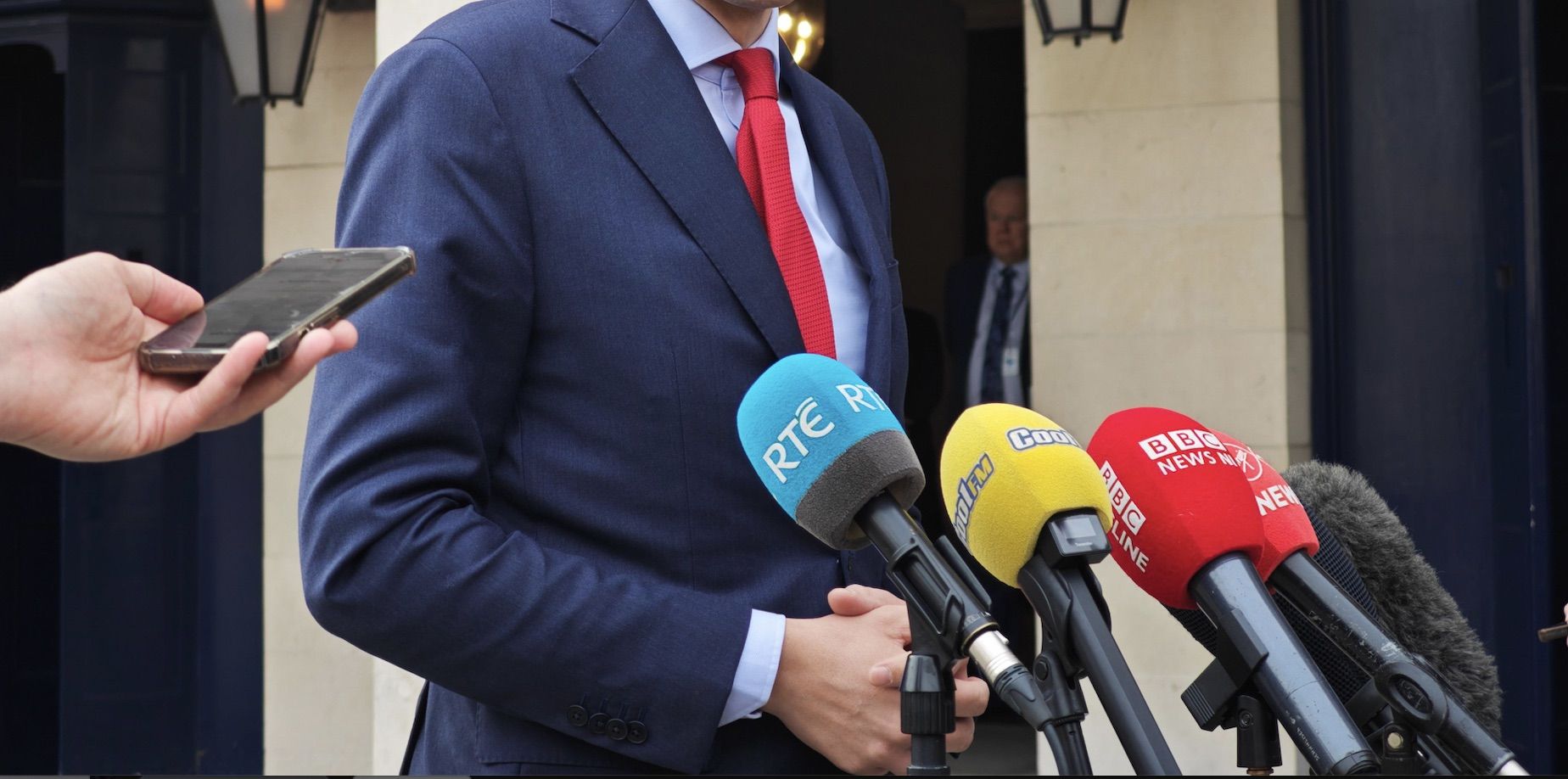

The report asserts that it is possible to harness all the media that is currently available across Ireland and to shape a PSM to reflect the influence and experience of these mediums. It also recognises the importance of the Irish language media and Ulster Scots broadcasts and the growing numbers of ethnic people now living in Ireland.
The report argues that Public Media Ireland should reflect a much broader view of Irishness and diversity, not merely multicultural, but intercultural. It poses some pertinent and immediate questions for advocates of a new Ireland.
Can a space be created in which nationalist and unionist identities are reconciled? How can unionist and loyalist identities be maintained and respected in a post-union context? How can the Good Friday Agreement contribute to achieving this? And what compromises might advocates of reunification be willing to make?
The values of the new medium should reflect the six key values of the European Broadcasting Union: universality, independence, excellence, diversity, accountability and innovation.
The report touches on many other aspects of a public service medium including how it should be funded.
The report makes it clear that this is only the beginning of the conversation. And it is a very good beginning. Many thanks to the authors of this important contribution to the discussion about the future.
Thanks, Jim
WELL done to the Moore Street Preservation Trust, which has announced a new raffle to raise funds for the legal action to save the iconic 1916 Moore Street Battlefield site in Dublin.
The Trust faces an expensive court hearing this year in its efforts to challenge the plans of the developer Hammerson, which would destroy buildings and a cultural landscape linked to the historic events of the 1916 Easter Rising.
The Moore Street Preservation Trust is raffling our hugely popular Elizabeth O’Farrell print – a unique, framed print designed and signed by the renowned Irish artist Jim Fitzpatrick. Míle buíochas, Jim. The draw will take place on Good Friday, April 3, 2026.
Tickets are €5 / £5 and they can be bought at: msptshop.myshopify.com
Slán, Mickey
FINALLY, condolences to the family of former republican MP and MLA Mickey Brady. News of his sudden death has saddened and shocked all of us who knew him. My solidarity to Mickey’s wife, Caroline, his children and grandchildren, comrades and friends.
RIP: Mickey Brady photobombing at Stormont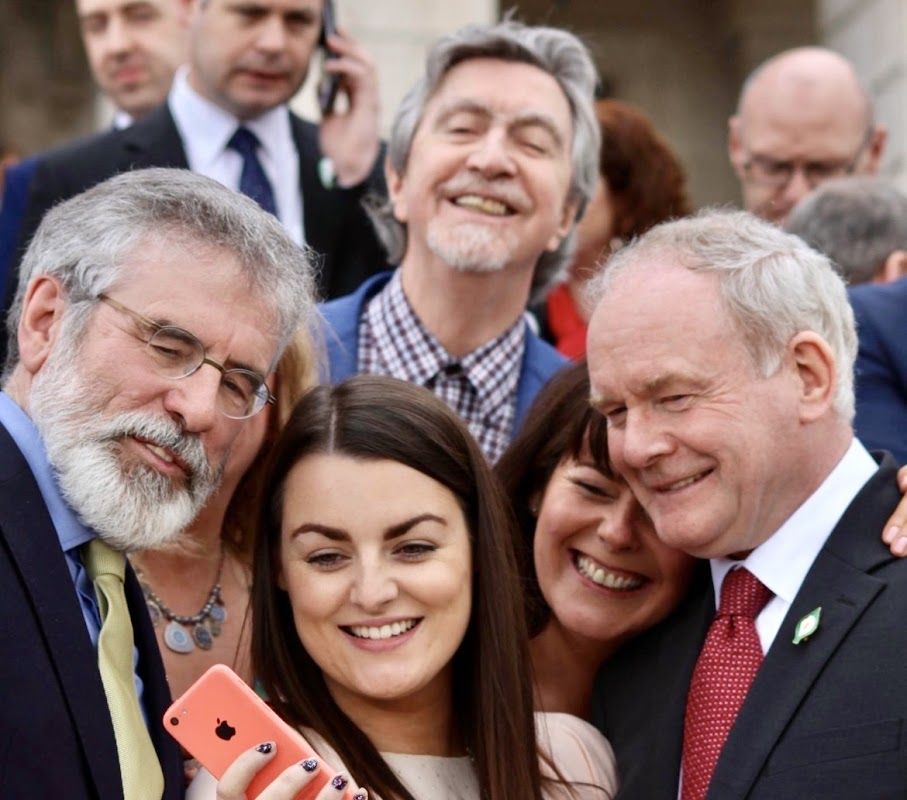
He will be deeply missed by us all, and especially the good people of Newry and Armagh who he served diligently and enthusiastically through a lifetime dedicated to Irish republicanism and activism. Tá Mickey ar slí an fhirinne anois.