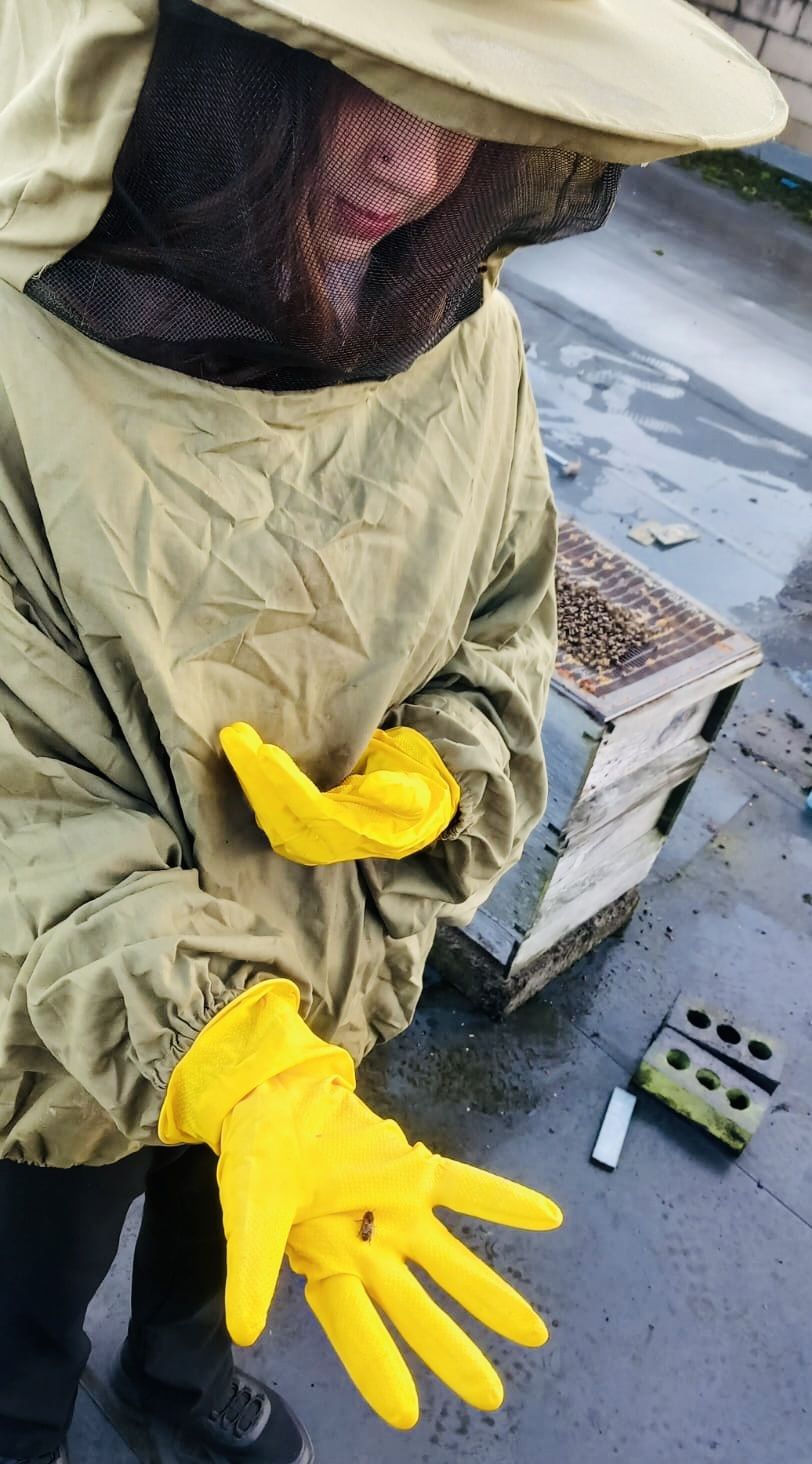
THESE bees are our finest local residents – because they literally consist of the Best of the West.
They happen to occupy prime real estate on the roof of Coláiste Feirste in Beechmount from which they can collect nectar from our natural wonders like Black Mountain, the Falls Park, the Bog Meadows and even as far away as Colin Glen.
And given that they feed in a radius of 3km, they couldn’t have a better spot to build their home.
These bees are of course the native Irish variety, which is under threat from other honey bees imported from abroad. We’ve exactly 100 native bees (Irish nature likes to give us easy-to-remember numbers – conveniently we’ve 32 native butterflies!). The Irish honeybee, beach mheala – a subspecies of the dark European honeybee – has relatively recently been recognised and protected, probably just before it would have been forever lost.

Coláiste Feirste’s beehive initiative was started a decade ago under the ingenious name ‘Bí Gaelach’. Dúlra has never had the privilege to taste the honey, but considering it literally contains elements of our finest natural attractions, it must taste better than the finest French wine. And it’s certainly better for you – it’s said that eating local honey is especially good for those with allergies because it contains pollen from nearby plants, giving the honey the exact variety of species that people in the area are triggered by.
When these bees leave their hive, they can drop into local gardens, but the real attractions are further afield. And when they return laden with pollen, it’ll be from the heather of Black Mountain, the orchids of Colin Glen and the yellow irises of Bog Meadows. How’s that for a stew of magic?
When Dúlra learned that the school’s Grúpa Eiceolaíochta – Eco Group – were going on to the roof last week to tend to the hive, he hoped he’d finally get a spoonful – but alas it was not to be. It seems the series of autumn storms were so severe that the bees were forced to stay indoors for long periods – and they kept themselves alive by eating all the honey.
The visitors found that the population was still healthy with hundreds of bees, who will stay safe inside the hive to protect their queen, who come spring will be laying 2,000 eggs a day, bringing the famous Coláiste hive into full honey production. Surely next year they’ll keep a wee jar of Bí Gaelach for the local nature correspondent?
• A reader filmed a bloody killing this week at her own front door – a sparrowhawk devouring a pigeon.
She got out of her car with her shopping to go into her house in Tullymore Drive in Andersonstown but was stopped in her tracks by the scene – and the sparrowhawk wouldn’t budge until it had eaten its fill!
“I was only a few feet away but the hawk was just standing on the dead pigeon and ripping it apart as if I wasn’t there. I even had time to get my phone out and film it,” she said.
It’s a female sparrowhawk – in the raptor world, females are bigger than males and only she has the strength to take on a pigeon. It’s heartening that these fantastic hawks are still patrolling the urban gardens of West Belfast, as they have done since Dúlra was a pup.
They zip up and down the gardens, pouncing on unsuspecting victims, be they sparrows, starlings or pigeons. It takes so much energy and skill to get a kill that they have to eat it immediately – even if someone is trying to get in their front door with their shopping!
These birds breed on the more remote corners of Black Mountain and it’s great that their population is still healthy enough that they can drop down into the city for easy pickings.
If only they would stop carrying out their bloody executions on our front doorsteps!
•If you’ve seen or photographed anything interesting, or have any nature questions, you can text Dúlra on 07801 414804.